
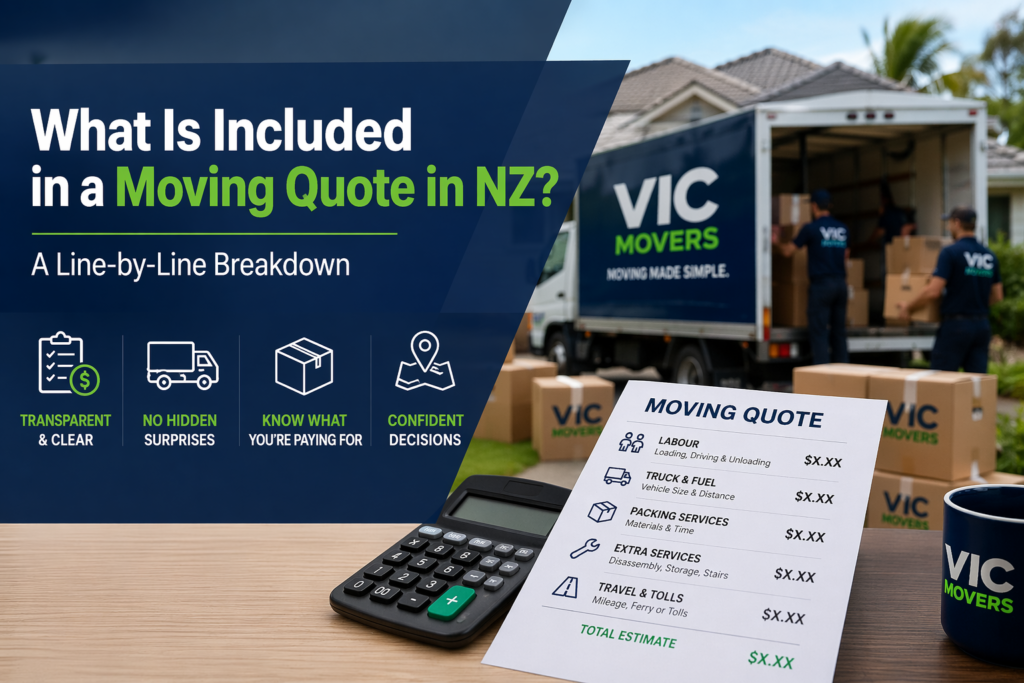
You have reached out to a few moving companies, and the quotes have started arriving in your inbox. Some are detailed spreadsheets. Some are a single number with almost no explanation. Some are in the middle. And you are sitting there wondering what you are actually paying for and whether you are comparing apples with apples.
This is one of the most common frustrations for anyone planning a house move in New Zealand. A moving quote in NZ can look very different from one company to the next, and unless you know what each line item means, it is almost impossible to make a confident decision.
This guide breaks down every component of a professional moving quote, explains what should always be included, what is sometimes optional, and what might be hiding in the fine print. By the end, you will know exactly what questions to ask and what a fair, transparent quote actually looks like.
Why Moving Quotes in NZ Vary So Much
Before getting into the line-by-line breakdown, it helps to understand why moving quotes in NZ can differ by hundreds or even thousands of dollars for what appears to be the same job.
The reality is that moving is not a standardised service. Two companies quoting on the same three-bedroom house move may be offering completely different things. One might include full packing materials. Another quotes labour only. One prices based on cubic metres. Another charges by the hour. One includes transit insurance. Another does not mention insurance at all.
This is why understanding a moving quote breakdown NZ is not just useful. It is essential if you want to avoid nasty surprises on moving day or on your final invoice.
The Core Components of a NZ Moving Quote
1. Labour Costs
This is almost always the largest single item in any moving quote NZ. Labour refers to the cost of the moving crew who will load, transport, and unload your belongings.
Most NZ moving companies charge labour in one of two ways:
Hourly rate: You pay per hour for the number of removalists working on your job. Standard rates in New Zealand typically range from around $120 to $180 per hour for a two-person crew, though this varies by region, company size, and time of year. Auckland and Wellington tend to sit at the higher end.
Fixed price: Some companies will assess your home, calculate the estimated volume and complexity, and provide a flat rate for the entire job. This gives you cost certainty, which many families prefer.
When reviewing labour costs, always check:
- How many crew members are included
- Whether the clock starts when they leave their depot or when they arrive at your door
- Whether there is a minimum charge, commonly two or three hours
- Whether weekend or public holiday rates apply
2. Truck and Equipment Fees
The moving truck cost NZ is either included within the labour rate or listed separately. A professional quote should clearly indicate what size truck is being used, as this directly affects how many trips are required and therefore how long the job takes.
For a standard three-bedroom home, most professional movers will use a truck sized between 40 and 60 cubic metres. Larger homes may require a bigger vehicle or multiple trucks.
Equipment fees may also appear separately and can include:
- Furniture trolleys and moving dollies
- Moving blankets and furniture pads
- Straps and tie-downs for securing loads
- Stair climbing equipment for multi-level homes
A reputable company will include these as part of the standard service. If they are listed as extras, ask why.
3. Packing Materials
This is where quotes start to diverge significantly. Some companies include basic packing materials. Others charge for every box, roll of tape, and sheet of wrapping paper separately.
Common packing materials that may appear as line items include:
- Cardboard boxes (small, medium, large, and wardrobe boxes)
- Butcher’s paper and tissue paper for wrapping fragile items
- Bubble wrap for glassware, ceramics, and electronics
- Mattress covers and sofa wraps
- Packing tape and dispensers
- Marker pens and labelling supplies
If you are using the company’s packing services NZ, all materials should be clearly itemised so you know exactly what you are getting. If you are self-packing, confirm whether the company supplies any materials at all or whether you need to source everything yourself.
Boxes alone can add up quickly. A three-bedroom home typically requires between 60 and 100 boxes depending on how much you have accumulated over the years.
4. Packing and Unpacking Services
Separate from the materials themselves, the labour involved in packing is charged as its own service. Professional packing services NZ involve trained staff carefully wrapping and boxing your belongings before moving day.
This service is broken into two parts:
Pre-move packing: The crew visits your home one or two days before the move and packs everything systematically. Fragile items, kitchen contents, linen, books, and clothing are all handled professionally.
Unpacking service: After delivery, the crew places items in designated rooms and removes all packing materials from your new home.
Both of these are optional services, but for families with large homes, fragile collections, or simply limited time, they are worth every dollar. When comparing quotes, check whether packing is included or whether it carries an additional hourly or flat-rate charge.
5. Disassembly and Reassembly
Large furniture items like bed frames, wardrobes, dining tables, and desks often need to be taken apart before they can be moved safely and reassembled at the destination.
Some moving companies include basic disassembly and reassembly in their standard service. Others charge an additional fee per item. This is a detail that catches many people off guard when the final invoice arrives.
Ask specifically:
- Is disassembly and reassembly included?
- Are there items they will not reassemble, such as flat-pack furniture or complex wardrobe systems?
- Do they carry the necessary tools, or do you need to provide them?
6. Transit Insurance
This is one of the most important lines in any moving quote NZ and unfortunately one of the most frequently glossed over.
Transit insurance covers your belongings against loss or damage while they are in the care of the moving company. In New Zealand, movers are not automatically liable for the full replacement value of damaged goods unless they carry specific transit insurance.
There are generally two levels of coverage to be aware of:
Basic liability: Some companies include a basic level of coverage, but this often only applies to damage caused by proven negligence and may have per-item limits that fall well short of replacement value.
Full transit insurance: This is comprehensive coverage for the declared value of your goods during loading, transit, and unloading. It may be included in the quote or offered as an optional add-on, typically calculated as a percentage of the total declared value.
Always ask what insurance is included, what the claims process looks like, and whether you need to arrange additional coverage through your own contents insurer. For valuable items like antiques, artwork, or high-end electronics, this conversation is non-negotiable.
7. Long Distance and Inter-Island Fees
For long distance movers NZ jobs, particularly those involving travel between cities or an inter-island move NZ, additional charges will appear in the quote that you would not see on a local job.
These typically include:
Fuel levies: A charge to cover the cost of fuel for long-distance travel. This may be a flat fee or calculated per kilometre.
Ferry costs: For moving from North Island to South Island, the cost of the ferry crossing for the moving truck must be included. This covers the vehicle booking, port fees, and driver costs during the crossing. Always confirm this is in the quote rather than being estimated and added later.
Driver accommodation: For multi-day jobs, drivers may require overnight accommodation which should be accounted for in the total cost.
Overnight storage: If your goods arrive before you can take possession of your new home, the company may need to hold your belongings in a secure storage facility overnight. Some companies include a night of storage. Others charge daily rates.
8. Surcharges and Additional Fees
This is the section where less transparent companies hide costs that inflate your final invoice. A professional quote will list these upfront. Here are the most common surcharges to watch for:
- Stair fees: If your home has stairs, particularly more than one flight, many companies charge an additional fee per flight or per item carried up or down.
- Long carry fee: If the truck cannot park close to your front door and the crew has to carry items a significant distance, this may attract an extra charge.
- Bulky item fees: Grand pianos, pool tables, large safes, and oversized furniture may be quoted separately due to the specialist equipment and extra crew required.
- Narrow access fee: Older homes or apartments with tight hallways, small doorways, or limited vehicle access can create additional challenges that movers factor into the price.
- Cancellation and rescheduling fees: Understand the company’s policy if your settlement date shifts or your plans change.
9. GST
In New Zealand, all professional moving quotes should clearly state whether the price shown is inclusive or exclusive of GST. A reputable company will always include this information. If a quote does not mention GST, assume it will be added on top and factor that 15 percent into your comparison.
How to Use This Breakdown When Comparing Quotes
Now that you understand what should be in a moving quote breakdown NZ, here is a simple process for making a fair comparison:
- List every service you actually need before requesting quotes, including packing, disassembly, insurance, and storage.
- Request itemised quotes from at least three companies so you can compare line by line.
- Confirm GST inclusion on every quote before comparing totals.
- Ask specifically about surcharges relevant to your property, stairs, access, or fragile items.
- Verify insurance coverage in writing, not just verbally.
- Check what happens if dates change and whether any fees apply.
The goal is not always to find the cheapest moving quote NZ. The goal is to find the quote that gives you the most complete, transparent picture of what you are actually getting for your money.
A moving company that takes the time to explain every line of their quote is almost always the company that will take the same care with your belongings on moving day.